








Should you hire before the end of the year or wait until January?
It’s the end of the year, headcount has been approved, and the suggestion has been made to defer the search for the new hire until the new year. The holiday season is approaching calendars are filling quickly, and January appears to offer a cleaner starting point.
But what looks like a short pause tends to carry more weight than expected. A search started now should deliver a new hire in early 2027, while one beginning in mid-January could point to a start date in March or April. When making the decision to hire now or later, employers should consider how long the business can afford to operate without the role filled.
What waiting until January really costs
Consider this timeline, for example: two weeks to cover the market, two weeks of interviews and four weeks of notice results in an eight-week hiring process from briefing to start date.
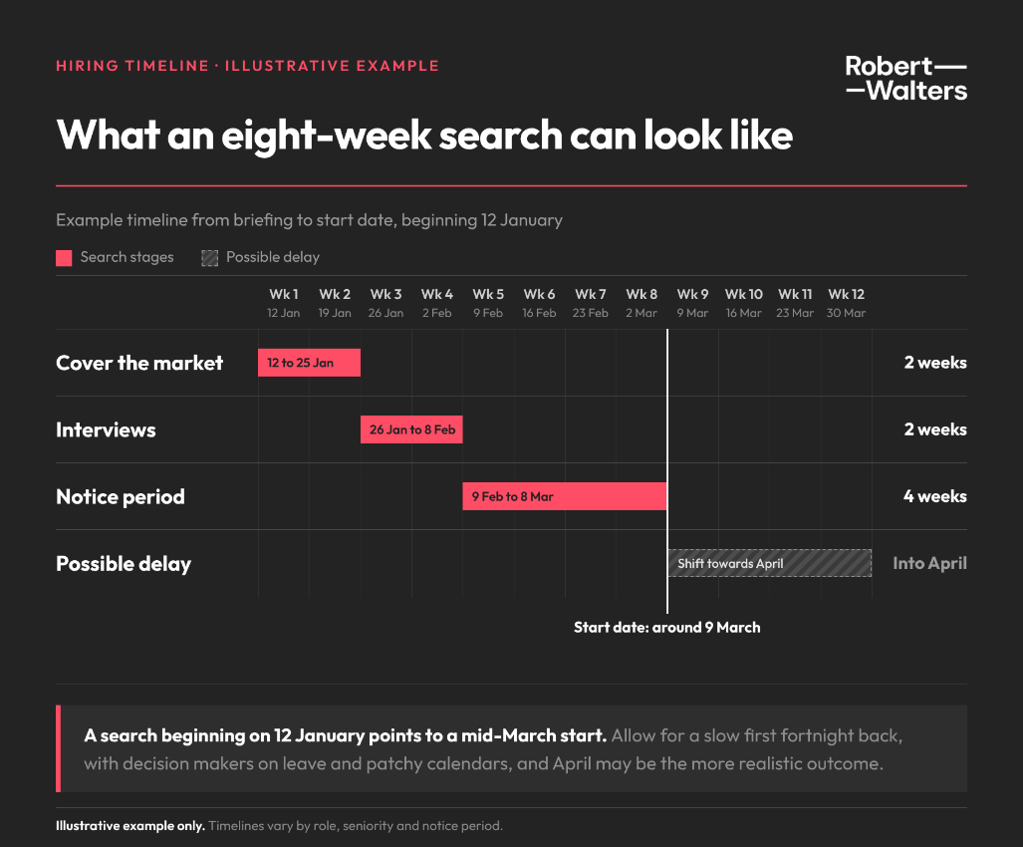
That means that a search beginning on the 12 January would eventually land in mid-March. Allow for a slow first fortnight back, with decision makers on leave and patchy calendars, and April may even be the more realistic outcome.
It’s understandable that every search runs differently, and notice periods can vary widely. But even with allowance for this variation, it is still close to a full quarter without the role filled. For a revenue generating position, a leadership gap or a team already stretched thin, leaving the role empty for that long can cost the business more than hiring during a busy month.
The case for hiring at the end of the year
Many strong candidates want certainty before the break, and a good offer made in early December can settle a decision that would otherwise sit unresolved over summer.
There may also be less competition than you might expect. Plenty of employers pause activity from late November, which means the candidates still in the market are seeing fewer opportunities. Moving now means, you have the advantage of a candidate’s full attention, with fewer competing conversations to contend with.
The practical result is gaining a head start. Running interviews through November and early December and making the offer before the shutdown sets you up with a January start. You enter the new year with the role filled or close to it, rather than just beginning the search.
The case for waiting until the new year
Some professionals prefer to wait until bonuses are paid before resigning, which can push candidate movement into late January and February. If your role depends on reaching people who are staying put until then, a January search could reach a bigger pool.
Budgets are also a key factor. If headcount is still being confirmed or the role is still taking shape, a short period of preparation can help. A clear brief and approved budget give you a stronger start, and candidates tend to respond well to a process that is well defined from day one.
It is still important to note that this wave arrives alongside fresh budgets and a surge of employer demand. Whilst there may be more candidates, there are also more companies competing for them.
How to decide whether to hire now or wait until the new year
Move now if the role is business critical, the skills are scarce, and if the hiring manager and interview panel can commit time through to mid-December. A decisive process at the end of the year beats a competitive one in February.
Wait if the budget or scope is uncertain, if key decision makers are unavailable for the next three weeks, or if the role depends on candidates who are unlikely to move before bonuses are paid.
For employers sitting somewhere in the middle, the best answer is usually to start the search now. Give your organisation the chance the brief the market, run first interviews and secure the strongest candidates while others are on pause.
Making a pre-Christmas process work
A shorter timeline requires a more disciplined process:
- Lock in interview dates before the search begins
- Agree who has authority to make the offer, so approval does not stall over as people go on leave
- Keep the recruitment process to two or three stages
- Give candidates a clear timeline and stick to it
- Plan the new year start carefully, including first week logistics, early priorities and onboarding programs
Candidates read speed and clarity as signals of how a business operates. When interviews are scheduled promptly, feedback is clear and decisions are made on time, that experience alone can strengthen your employer brand more than any careers page.
The takeaway
A new year offers a fresh start, and for some roles it is the right time to begin. But for some businesses, hiring at the end of the year is about recognising the real cost of waiting, avoiding the risk of a longer vacancy and getting ahead while the market is quieter.
Whether you are ready to hire now or are planning for early 2027, our consultants can walk you through current candidate availability and what a realistic timeline looks like for your search.
FAQs
-
Is it harder to find candidates in December?
Not necessarily. Some candidates pause their search over the Christmas period, but some will also remain open to the right role, especially if they want some certainty or peace of mind before the break. With fewer employers actively recruiting in December, candidates who are still looking may see fewer opportunities, which can work in favour of employers who keep moving. -
Are candidates less likely to accept an offer during the holiday period?
It depends on the candidate and the role. Some are keen to resolve their position before the holidays, while others prefer to wait until after the break to decide. Employers can reduce hesitation by making the offer clear, setting a response date and staying in regular contact. -
Should I use a contractor or temp to cover a role until a permanent hire starts?
A useful starting point is to consider what having that vacancy open puts at risk. If it affects revenue, delivery or team capacity, interim cover can be worth considering while the permanent search runs. If the impact is limited, the cost and onboarding effort of a short-term hire may not be justified. -
How do I speed up a hiring process without lowering quality?
Speed usually comes from preparation rather than shortcuts. Agree on the brief, decision makers and interview dates before the search begins, keep the process to two or three stages, and give candidates a clear timeline. These steps remove the waiting time that slows most searches, without reducing how thoroughly candidates are assessed.
Related content
View All
On-demand recruitment means adding dedicated recruitment capacity when hiring demand rises, then scaling it back once the hiring requirement has been fulfilled. This is usually done with the help of an external team for a defined period. It doesn't need to expand the internal team permanently or spr
Read More
Robert Walters has been recognised as a Major Contender and Star Performer in both Everest Group's 2026 Contingent Workforce Management (CWM)/Managed Service Provider (MSP) and Services Procurement/Statement of Work (SOW) PEAK Matrix® Assessments. This dual recognition highlights the strength of our
Read More
Leadership has never been just about expertise, experience or having the right plan. When change is constant and uncertainty is part of everyday working life, how you lead people matters just as much as the decisions you make. Human-centric leadership shifts the focus from the leader to the people t
Read More